How to
Unclench
Some ideas are so potent, they have the capacity to radically shift the trajectory of your life. The most impactful and practical idea I have ever discovered, is unclenching.
Once you see it, you can't un-see it. If you let it, it will radically shape your perspective on yourself and the world around you.

Jonny MillerFounder, Nervous System Mastery
Have you ever noticed how whenever you are in a little bit of a hurry, you clench?
Isn't it bizarre how when you're around someone you don't trust, you clench?
Isn't it interesting how when you are anticipating critical feedback, you clench?
Last weekend I running (literally running) late for a flight. I was standing on the other side of customs, waiting for my carry-on bag to emerge from the x-ray machine. It emerged and was pulled aside into the a long queue of equally untrustworthy bags.
As you might have guessed – my entire body was indeed clenched, from head to toe.
Why the fuck is this?
Why might it be that clenching our muscles is something that human biology has evolved to do, even when it seems to serve no immediate purpose. Why is it that a rapacious inner critic or stressful moments appear to co-arise with body-tension?
Why isn't this something that people are talking about or scientists researching in labs? Why is it weird for me to be writing a essay titled 'How to Unclench'
Clenching my jaw certainly didn't help speed up the process of retrieving my bag and catching my flight.
The Spectrum of Clenching
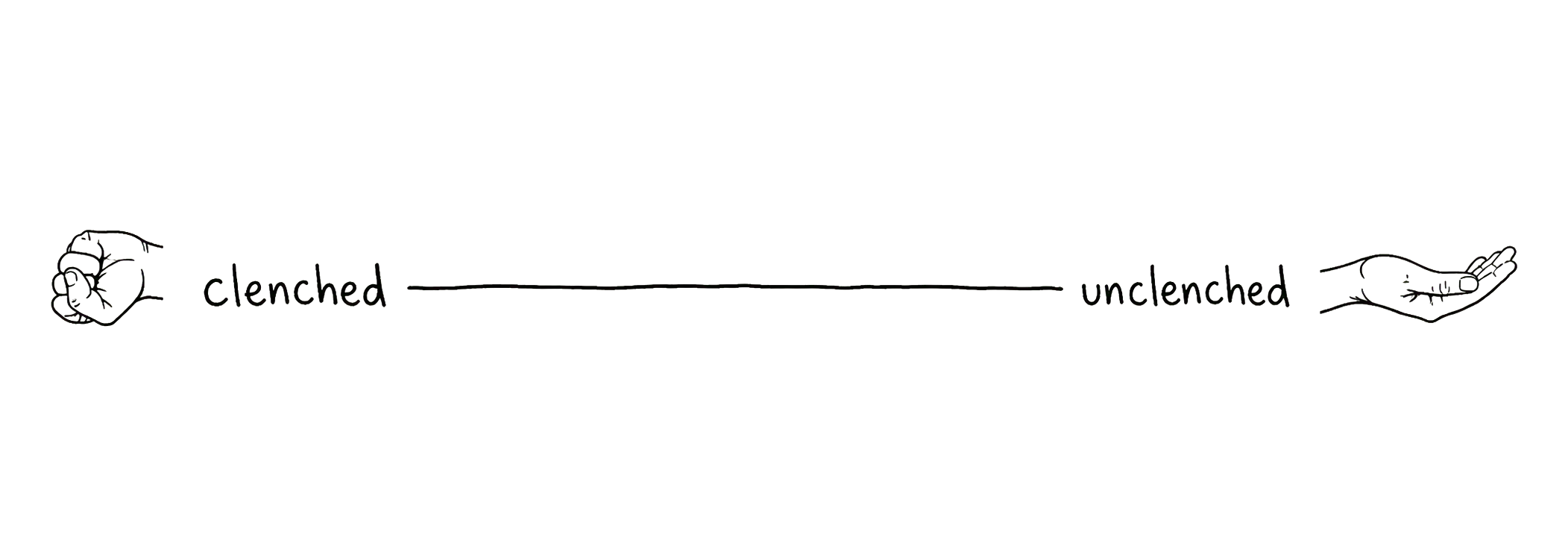
It turns out that the word anxiety (something that almost everyone seems to be experiencing these days) derives from the Latin substantive ‘angor’ and the corresponding verb ‘ango’ — meaning ‘to constrict. In Roman times Cicero in fact characterised it clinically as a 'constricting disorder'
To generalise from my personal experience (maybe this tracks for you as well), every time that I have said something that I later regretted, made a poor decision, or engaged in some additive shitty behaviour, I have been somewhere on the left-hand side of this clenched spectrum. Which is to say that clenching reduces your capacity for living intentionally and is a bottleneck on agency in your life.
That sounds like a big deal right? Things get even weirder.
"Time and again, I find that what gets me unstuck is a psychological ‘move’, a shift of orientation, that I’ve only ever been able to describe using the word unclenching... it seems to be my default response to uncertainty or overwhelm or other difficulties to tighten up against them so as to hold them at bay – when in fact that leads only to paralysis and a sense of sterility."
– Oliver Burkeman, Author of Four Thousand Weeks
It turns out (and this has also been my lived experience) that the exact opposite is true on the right hand side of the spectrum
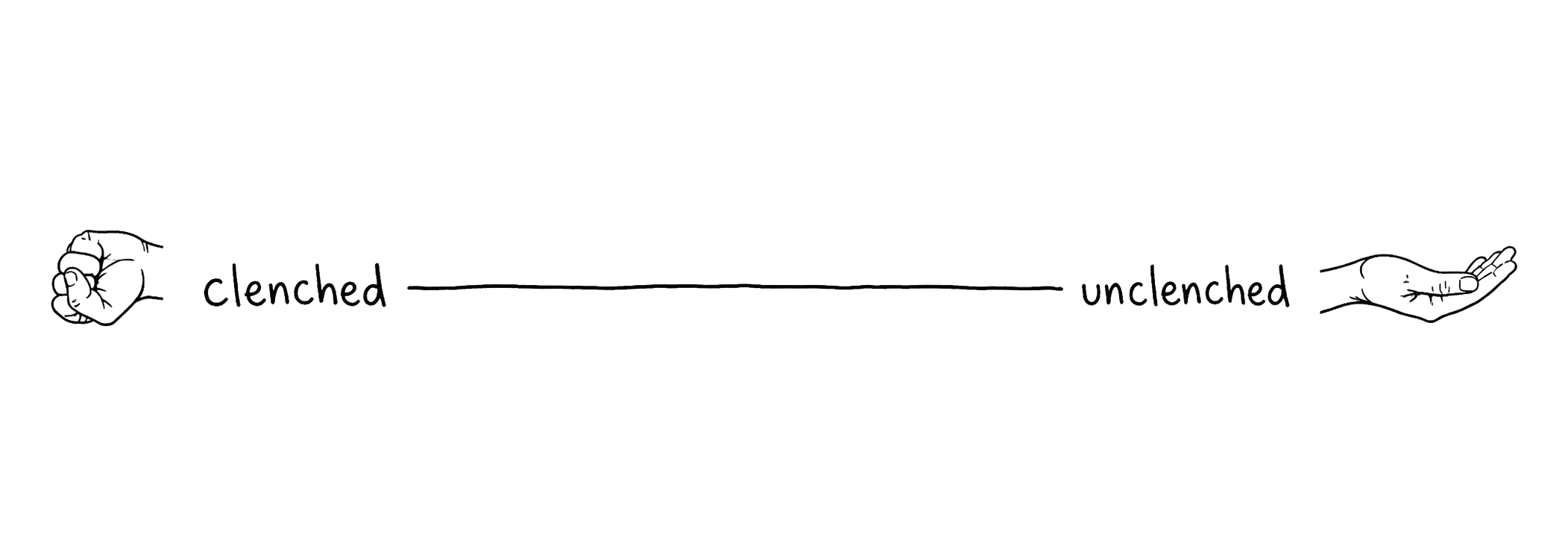
i.e. unclenched states, directly correlate to felt-sense experiences of connection, flow, joy, contentment... even blissful states and profoundly altered states of consciousness identical to those experienced on high-dose psychedelics.
And furthermore, these altered states can become altered traits, where your default baseline of happiness is not 30-50% higher, but according to many a 30-50x higher level of baseline happiness.
I repeat, what the actual fuck?!
I'm going to make an absurdly bold claim: that this act of clenching (which is of course a spectrum), is in fact the literal, upstream cause of your suffering in life, and that the solution, is simply to unclench.
There could be a parallel universe in which a version of you with the exact same life circumstances, the same job, the same amount in the bank account and the same relationships experienced orders of magnitude more contentment, ease and joy in their life, not because anything was different on the outside, but because they were less clenched on the inside.
In this essay, I'm going to do my best to make the case for how the emerging science of clenching and the weird skill of running unclenching loops, might just alter the trajectory of your life.
I. Why Do We Clench?
i. Clenching is a Prediction
Question: if clenching causes so much suffering to humans then how did it get passed down through hundreds and thousands of years of evolution? Surely it must be adaptive and still serving a useful purpose?
Answer: Yes, clenching was certainly essential for our ancestors survival. On the most basic level, clenching is your nervous system predicting that 'something bad is likely about to happen'. It's like taking a pre-payment for some kind of action.
As such it is a fantastically useful, short-term protective mechanism. If you're walking through the jungle and you see a long thin object on the path, it's more adaptive to assume that it's a snake and prepare to run, rather than walk closer to examine if it is indeed a rope.
Question: What's the downside then?
Answer: When you clench (in small or large ways), you are expending more energy than is strictly necessary. It's a bit like an insurance policy, you're spending extra energy in exchange for greater predictability.
And as such you are also narrowing down your options, meaning that you will likely react in knee-jerk ways.
Have you noticed how some old people with stiff and tight looking faces tend also be stubborn and stuck in their ways? Well the rigidity also occurs on a cognitive level: we collapse nuanced exploration into binary thinking, our perceptions are more rigid.
You can imagine the opposite of this as being rigor mortis, when someone dies ATP stops being produced and what happens?
build up to a man in his early 30’s sitting and the entire world is gray. As all of the above was happening the aliveness (color) was being drained from the view.
ii. Sticky Clenches
Broadly speaking, there are two types of clenching:
short-term clenches: these are clenches held for brief durations. These come and go.
long-term clenches that persist: these persisting clenches are called 'latches' (because of the 'latch-bridge' mechanism that is engaged, but more on that later). It's common for there to be numbness or reduced sensation in areas where there are lateral
iii. Clenches Defend Against Scary Emotions
If there's one idea that I could put on a billboard to be seen by a billion people it would be this:
"There is such a thing as a negative emotion."
Here's the thing: most people have never experienced their emotions without clenching.
It's easy to understand how certain clenches against emotions become habituated. For example if as a kid you expressed anger in the playground, you were likely told to stop or punished. Perhaps if you are a man and you cried in public, then you were teased. Either of these experiences will likely cause the predictive clenches to lock in.
On a day-to-day level, we have a word for clenched excitement, we call it fear. You can run the experiment for yourself: next time you’re afraid about something, jump up and down and say I’m excited I’m excited I’m excited ten times and notice what happens.
Terror is relatively rare in our lives, but in the moments that it happens, typically deep meditation openings, near death experiences or heroic doses of pyschedelics, as many will confirm if you can unclench in the face of terror it opens up into a rapture and awe.
I viscerally remember the first time I was experiencing intense grief, and it opened up into such intense and overwhelming love that something changed in me on a fundamental level.
In 2017, my former fiance took her own life, and as I was walking towards her memorial bench on a beach in the south east corner of the UK. I could feel the intense waves of grief about to roll through. And falling down onto my hands and knees I sort of surrendered and allowed myself to be overcome by the feelings, and they almost instantly shifted into an overwhelming, raw sense of love.
What a Latch Release Looks Like (LeAnn Rimes Video)

iv. A Brief Intellectual History of Unclenching
Wind the clock back to 500 BCE and Siddhartha Gautama (aka the Buddha), figured out unclenching, in fact he called it the 2nd noble truth that clenching (tanhā in his language), is the root of suffering (dukkha).
Fast-forward to the 19th century and students of psychotherapy pioneered what is now vaguely pointed to as ‘somatic work’.
Specifically Wilhelm Reich pioneered the idea that our chronic psychological defences presented as what he called “character armor” which are rigid personality patterns. His approach was to use a combination of breathwork, direct manipulation and emotional release to help dissolve this unclenching.
Soon after, one of his brilliant students, Alexander Lowen, mapped these chronic muscular holding patterns into a system he called the 'five character structures’ – essentially five clenching styles that the human body learns in order to defend against feeling unsafe or unwelcome, typically quite early in life.
Then unfortunately, the field of psychotherapy took a turn away from the body, and moved more into the realm of 'talk therapy', which in my experience can be a helpful first step towards making changes, but (in my opinion) rarely addresses the root cause of suffering and it's common to hear of someone going to therapy for a decade without any significant breakthroughs or shifts in their life.
II. How to Unclench
The main point I wish to make in this essay is that unclenching is a trainable skill. If you can run self-guided experiments and track your learnings (I call this loops) then you will almost certainly make huge strides over time in your unclenching adventures.
No-one was ever taught how to unclench: sure there are some cliches that you'll encounter in self-help circles like "Let go or be dragged." or "That which you resist, persists." but personally I didn't encounter much that was significantly more helpful than "just surrender bro"
So this is my attempt at creating a map for others to follow.
Five Trainable Skills for Running Unclenching Loops
Wait, What is a Loop? Loops are a hot topic in AI at the moment. The concept is that once you can define an outcome, it's possible to run endless loops to optimise and solve for it. The unclenching loop is the same philosophy but applied to personal growth.*
By running and clenching loops for yourself, you will be inherently training your capacity in these five skill areas. however it is helpful to get a benchmark since this will help illuminate specific areas that may benefit from deliberate practice.
i. Interoception Your 'Interoceptive' sensitivity is your capacity to sense, track and feel your inner landscape - which refers to internal sensations, feelings or experiences.
ii. Self-Regulation 'Self-regulation' refers to your ability to send internal safety signals to your nervous system
iii. Emotional Fluidity 'Emotional Fluidity' refers to your ability notice and express the full spectrum of emotions without any resistance, judgement or tension.
iv. Meta-Cognition Meta-cognition is your capacity to see reactive behaviour as protective predictions and creating sufficient psychological space to not believe everything you think
v. Self-Relationship Self-relationship is your capacity to relate without shame or judgement to any reactive or defensive behaviour as a protective response, rather than proof that something is inherently wrong with you.
The Three Levels of Unclenching Loops
Level 1: Self-Exploration Loops
Just like sleep, you can't force it (this is another type of clenching), but you can create the conditions for it to happen.
Your nervous system is constantly tracking for internal and external signals for safety. They call this 'set + setting' in the psychedelic research world. Internal + External signals for embodied safety.
The common thread with all of the experiments below might be summarised as 'cultivating a secure attachment with reality' (a phrase coined by meditation teacher John Churchill). Or to put this in plain English, rewiring your nervous system to predict safety by default, especially in moments of uncertainty.
→ C.R.I.S.P. Attention
One helpful starting point is this: **"Curious attention, will dissolve your tension"
And I’ve noticed that in addition to curiosity there are four more qualities that increase the likelihood for unclenching to happen. The acronym I created for this is C.R.I.S.P.:
Curiosity + Relaxation + Intimacy + Safety + Playfulness.
One simple way to get started is to say each word to yourself, and notice what it feels like to inhabit that word fully. And then cycle through each of the five words at a pace of roughly one every minute or two.
Click on one of the cards below to try one of the guided practices
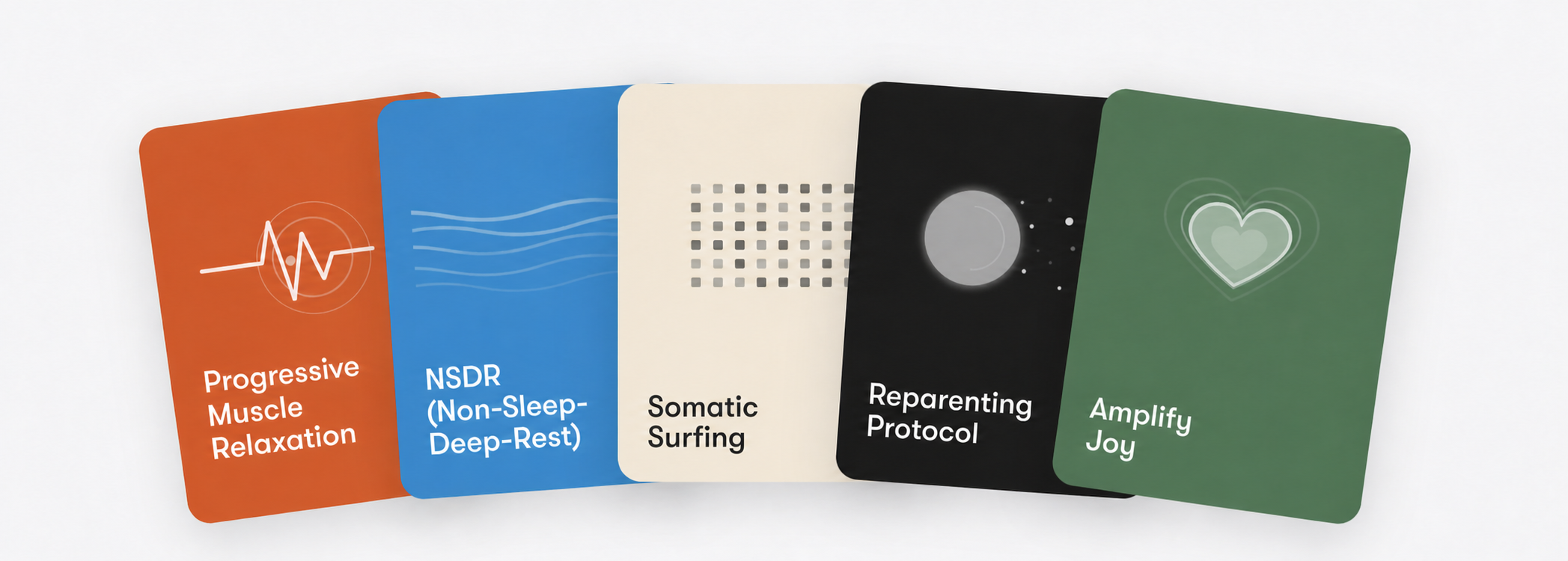
Level 2: Self-Exploration + Human Connection Loops
Think of Connection Mode as essentially borrowing nervous system capacity from another human who is offering you their non-judgemental presence.
On the most basic level you can experience this when you hug or cuddle a partner, close friend or even pet, you will notice yourself almost instantly unclench. It's really remarkable.
Whenever I've had a tough day or have clenched myself into a functional freeze state, a few minutes of spooning with my wife will bring me back to myself. It's one of the gifts that you can give to a loved one and it's usually more effective than any words.
We have discovered through running nine cohorts of Nervous System Mastery, that the students who experience life changing outcomes, are almost always the ones who engage in our Relational Dojo practice. This practice can be summarized as unclenching whilst in connection with another.
There are several flavors of structured human connection loops: Some that I have experienced and wholeheartedly recommend include Daniel Thorson's Arc Network, Joe Hudson's Connection Course, Pranab's Attn Co-pilot.
They're all slight variations on the same theme — that practicing forms of unclenching in connection with another human is without question a more efficient and sustainable path.
I personally prefer in person when possible, however, I've been pleasantly surprised by the potency of practicing via Zoom.
Connection Mode can also help to mitigate some of the pitfalls of self-exploration (it's surprisingly easy to bullshit yourself when you don't have feedback cycles), and in my lived experience you will eventually run into limits to the progress you can make on your own.
note: there are also some executive coaches (unclenching co-pilots) out there who can guide and design unclenching loops with you (Sasha Chapin, Stephen Zerfas, Alex Olshonsky and Derek Haswell being examples who I've witnessed work their magic first hand)
IV. The Body Does Keep the Score, Actually
Towards a Biological Definition of How Trauma is Stored in the Body
Here's an interesting quote from Professor Andrew Huberman:
“The operational definition of trauma is that some fear took place and somehow gets embedded or activated in our nervous system and shows up at times when it’s maladaptive”
Note that he says SOMEHOW it gets embedded or activated in our nervous system.
Does this seem odd to you that with all the talk about trauma today, no-one actually knows HOW the body keeps the score.
This might not seem like a big deal, but it is in fact an ENORMOUS issue. To explain why we’re going to need to go all the way back to the early 1800’s.
In that era physicians knew that diseases spread, but they didn’t understand how or why. They saw fevers sweep through towns. They watched infections spread from patient to patient. But they couldn’t see what was causing it.
So the best theories we had were guesses: maybe it was bad air, or moral weakness, or imbalance in the body’s humors.
Some observers like Snow in the 1840s suspected invisible agents, but no-one had actually seen them.
And CRUCIALLY microscopes were too primitive to SEE or MEASURE the bacteria. Then in the 1850’s there was a shift that changed the course of humanity.
The microscope technology improved and for the first time, humanity could look through a piece of glass and see the thing that had always been there: tiny organisms driving enormous amounts of suffering.
Koch created the first real method for linking specific microbes to certain diseases — suddenly viruses were measurable and very quickly treatable with precise and effective interventions.
Once the invisible became visible, the entire field transformed.
Right now, in lmid-2026, I believe that humanity is on the cusp of a similar breakthrough in the science of trauma.
It turns out that there is an emerging science of unclenching
Mike Johnson is a softly spoken savant. A renegade philosopher and neuroscientist, operating outside of academia, most known for his theories on 'neural annealing', the 'symmetry of valence' and more recently, what is in my view his magnum opus 'vasocomputation'.
(If you don't know what any of those words mean, don't worry, I'm going to share why they are practically relevant and how they relate to the unclenching hypothesis)

We have extensive data implying correlation between what is labelled 'trauma' and severe physical and mental health conditions including chronic health conditions, debilitating anxiety, heart disease, substance abuse suicidal ideation, treatment resistant depression, and potentially even cancer...
And whilst we can take photographs of the brain and track inflammation levels, we’re just staring at symptoms whilst missing the equivalent of a microscope to show us what’s actually happening at the level of mechanism.
Yes I know what you’re thinking — didn’t Van De Kolk write a book titled ‘The Body Keeps the Score’ (that sold 3 million copies)... but here’s the thing, there is very valid criticism of this book and critics not unfairly point out that the level of scientific rigor is close to zero.
In fact leading neuroscientists like Lisa Feldman Barrett, argue that everything including trauma is in our heads.
Barrett argues that everything, including trauma, is in our heads, and that actually “the brain keeps the score” – essentially dismissing the idea that trauma somehow lives in the body.
And as a result of this lack of being able to measure trauma, the landscape of treatment options, to put bluntly is a shit show.
Tens of millions of suffering humans are dolled out SSRIs which are known to be at best a short term bandaid, but do absolutely nothing for addressing the root cause. Suicide rates are increasing — with recently an incredible pioneer in the psychedelic research attempting to address trauma, Dr Nolan Williams taking his own life.
There are some interventions that are showing some potential, including MDMA-assisted therapy, and somatic based therapy... but the field is something of a wild west and the results of these are based on purely subjective measures which basically equate to the patient saying “well I seem to feel a bit better now”.
Again, we’re lacking the ability to make the invisible agent of trauma VISIBLE to our eyes.
But what if we could see it. What if we could not only see this invisible force called trauma but actually measure it. What if we could then understand about how to reliably, effectively and precisely release it — and then compare the efficacy of various therapies and interventions.
There is a backlash from neuroscience against the idea from Van Der Kolk that the Body Keeps the Score, and their critiques are valid saying that 'no nothing is stored in the body, but the brain is stuck on a prediction loop'
I want to tell you about an idea that 99.9% of the world has never heard of, but if it’s true — it has the potential to radically shift the entire healthcare system, and one day soon could completely change your life.
“The operational definition of trauma is that some fear took place and somehow gets embedded or activated in our nervous system and shows up at times when it’s maladaptive” – Andrew Huberman
He says SOMEHOW it gets embedded or activated in our nervous system. Does this seem odd to you that with all the talk about trauma today, no-one actually knows HOW the body keeps the score.
This might not seem like a big deal, but it is in fact an ENORMOUS issue. To explain why we’re going to need to go all the way back to the early 1800’s.
In that era physicians knew that diseases spread, but they didn’t understand how or why. They saw fevers sweep through towns. They watched infections spread from patient to patient. But they couldn’t see what was causing it.
So the best theories we had were guesses: maybe it was bad air, or moral weakness, or imbalance in the body’s humors.
Some observers like Snow in the 1840s suspected invisible agents, but no-one had actually seen them.
And CRUCIALLY microscopes were too primitive to SEE or MEASURE the bacteria. Then in the 1850’s there was a shift that changed the course of humanity.
The microscope technology improved and for the first time, humanity could look through a piece of glass and see the thing that had always been there: tiny organisms driving enormous amounts of suffering.
Koch created the first real method for linking specific microbes to certain diseases — suddenly viruses were measurable and very quickly treatable with precise and effective interventions.
Once the invisible became visible, the entire field transformed.
Right now, in late 2025, humanity is on the cusp of a similar breakthrough in the science of trauma.
We have overwhelming evidence that there is a direct correlation between trauma, especially early childhood trauma and severe physical and mental health conditions including chronic health conditions, debilitating anxiety, heart disease, substance abuse suicidal ideation, treatment resistent depression, and potentially even cancer...
This list is quite frankly ridiculous.
And whilst we can take photographs of the brain and track inflammation levels, we’re just staring at symptoms whilst missing the equivalent of a microscope to show us what’s actually happening at the level of mechanism.
Yes I know what you’re thinking — didn’t Van De Kolk write a book titled ‘The Body Keeps the Score’ (that sold 3 million copies)... but here’s the thing, there is very valid criticism of this book and critics not unfairly point out that the level of scientific rigor is close to zero.
In fact leading neuroscientists like Lisa Feldman Barrett, argue that everything including trauma is in our heads.
Barrett argues that everything, including trauma, is in our heads, and that actually “the brain keeps the score” – essentially dismissing the idea that trauma somehow lives in the body.
And as a result of this lack of being able to measure trauma, the landscape of treatment options, to put bluntly is a shit show.
Tens of millions of suffering humans are dolled out SSRIs which are known to be at best a short term bandaid, but do absolutely nothing for addressing the root cause. Suicide rates are increasing — with recently an incredible pioneer in the psychedelic research attempting to address trauma, Dr Nolan Williams taking his own life.
There are some interventions that are showing some potential, including MDMA-assisted therapy, and somatic based therapy... but the field is something of a wild west and the results of these are based on purely subjective measures which basically equate to the patient saying “well I seem to feel a bit better now”.
Again, we’re lacking the ability to make the invisible agent of trauma VISIBLE to our eyes.
Why I care about this personally (change of pace) — let me pause for a moment to share why this question is meaningful to me. My ex-fiance Sophie was diagnosed with bi-polar disorder and took her own life by overdosing on her own medication.
And in the years since I’ve gone deep down the rabbit hole, experimenting with breathwork journeys, guided mdma and ketamine assisted somatic therapy sessions — where it was obvious that in certain conditions where my body felt sufficiently safe, I had the experience of it unwinding and there would be intense emotional releases, on the other side of which I felt significantly happier, less anxious and more alive. So it has been incredibly frustrating to me that mainstream neuroscientists were labelling this as hokey woo stuff.
But what if we could see it. What if we could not only see this invisible force called trauma but actually measure it. What if we could then understand about how to reliably, effectively and precisely release it — and then compare the efficacy of various therapies and interventions.
And what if I told you that one renegade theoretical neuroscientist might have already discovered a way to making invisible trauma visible — and uncovered a biological mechanism for how the body keeps the score.
Then meeting Mike Johnson changed everything. Mike Johnson might be one of the most brilliant theoretical neuroscientists alive today. And he is proposing a radical theory that if validated will not only lead to scientifically validated trauma therapies, but revolutionize the entire medical system and create a new paradigm for health and what it means to live well.
I’ve spent the last couple of years getting to know Mike and better understanding his theory, and this is my attempt to share his ideas to a wider audience.
Mike’s hypothesis asserts that trauma is in fact stored in the body, specifically in somewhere that few neuroscientists ever thought to look — it’s in the smooth muscle vascular tissue.
Okay, here’s where we’re going to get technical for a moment, bear with me. Mike’s theory is that vascular tension acts as a special type of memory, which allows the brain and nervous system to store predictions about the world (known as priors).
Everyone was taught in school the vascular system is basically just “plumbing for blood” — tubes that transport nutrients & waste. Mike’s theory suggests this misses the vast majority of what this system does — the vascular system adaptively shifts tension to help neurons compute. In other words our vascular system is like a giant biological computer. Where a single sustained thought is a pattern of vascular tension.
Now here’s where things get interesting for the trauma story. These vascular clenches have a special property (originally proposed by Murphy and Rembold) called the “latch-bridge mechanism”. In simple terms, what this does is create a semi-permanent clench, which deprives neurons of blood, further preventing updates. In our experience this becomes a fundamental prediction about how we see the world.
Okay, let me zoom out and share why this maps onto my own lived experience and why it’s surprisingly practical.
I’ve had the experience — well over a thousand times at this point — initially in guided breathwork journeys, later with psychedelics and now it happens quite often — where at critical moments in the journey I feel a very physical release of tension, often accompanied with an expression of an emotion or clenching and releasing of my muscles.
And one very recent study published in Nature appears to support the idea that psychedelics and in particular serotonin has powerful vasoactive effects, lending support to the idea that
The story gets even more crazy… Not only does this give rise to a practical and scientific sandbox to measure and assess trauma intervention, but it also ties into the observable phenomenon of what in the East was labelled ‘Enlightenment’ (show screenshot of this study).
Essentially, when we’re born as babies our sense of self develops as a series of latches. Our sense of self allows us to navigate the world, but also drains aliveness and causes suffering. Researcher and meditation teacher Shinzen Young claimed that he would rather spend one single afternoon in his (current) awakened state — rather than live an entire lifetime as a highly attractive multi-millionaire.
A human who is able to safely and sustainably open all of his or her latches, is effectively enlightened. Their sense of self disappears, they feel completely safe and securely attached to reality.
Free live workshop
Design your first
unclenching loop.
Join me to explore this strange skill together, practise it live, and leave with a loop you can run in your own life.